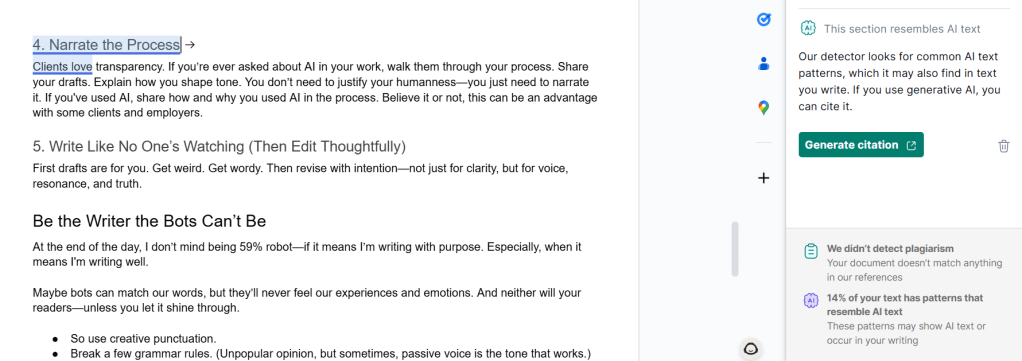
According to the bots, I’m 59% robot—1% on a good day.
This might come as a surprise for someone who has spent over a decade building brands, crafting captivating narratives, and sprinkling in em dashes like they’re spices in my secret family recipe. But lately, my writing is a little too smooth, a little too strategic, a little too… machine-like.
At least, that’s what the AI detectors say. If you’re now one with the word bots, read on.

When Your Creativity Gets Flagged
Not long ago, I was updating an article for SEO—one of those legacy pieces with solid bones but outdated references and phrasing. The original text scanned as 0% AI. Perfect! The bot’s working correctly. I was ready to breathe new life into it with sharper SEO structure, emotional nuance, and a lively tone that didn’t bore the reader to tears.
I wrote. I tweaked. I added some punch.
As I wrote, I watched the AI detector blink.
The percentage climbed.
And climbed.
And climbed some more.
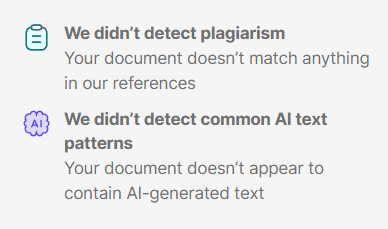
The more me I added, the more robotic the writing became—at least according to the algorithm.
Curious, I followed Grammarly’s suggestions. Shorten the sentences. Eliminate figurative language. Replace complex phrasing with more common alternatives. Gasp. Delete the em dashes.
You can guess what happened next.
The AI score increased.
That’s right. Following the “humanizing” edits made the writing more machine-like to the bots. Apparently, clarity is robotic now. So is style.
Welcome to the AI Detection Paradox
This experience threw me face first into the AI Detection Paradox: where the more human you write, the more you’re flagged as artificial. It’s as if creativity and individuality have been put on trial by tools designed to detect what makes writing not real—yet in doing so, they penalize what makes it deeply human.
- Turns of phrase.
- Unexpected rhythm.
- Emotion wrapped in punctuation and pacing.
These are the marks of a strong voice—but they’re also marks of a pattern, and patterns, to a bot, scream “AI.”
The Cost of Chasing the Algorithm
Let’s get real for a moment. For content marketers, editors, copywriters, and anyone working with SEO, AI detectors are now part of the process. Clients want 0% AI or they are all in and want you running their AI machines. On the other hand, publishers want assurances that what you submit is original, untouched by machine hands. We’re caught in the balance.
So what happens? We edit ourselves into oblivion. We trade our voice for a passing score.
But here’s the catch: when everyone writes to pass the test, we all start sounding the same. And sameness doesn’t build connection—it dilutes it.
In the race to sound less like a bot, we’re being asked to write like one. We become the machine and the machine gives us the green light to pass as human.
It’s dizzying, I know.
Staying Human (Even When You’re 59% Robot)
Let me say this plainly: your voice matters.
It matters more than your AI percentage score, and it matters more than Grammarly’s color-coded feedback. It’s how people connect to your work. It’s how your brand becomes something memorable—something felt.
And yes, you can still prove your authenticity without flattening your writing style into oblivion. Here’s how I like to approach it:

1. Build a Living Portfolio
Share writing that spans your range: blog posts, case studies, emails, captions, manifestos. Let clients, editors, and collaborators see that you’ve got rhythm and reason.
2. Blog Boldly—Like No One’s Scanning
Use your blog to publish the stories only you can tell. Let your language breathe. Let your voice evolve. Let the em dashes fly.
3. Post with Personality
Show up on social media with your signature wit, insight, or snark. Say something real. Say something you’d never outsource to ChatGPT. The real you is hard to fake.
4. Narrate the Process
Clients love transparency. If you’re ever asked about AI in your work, walk them through your process. Share your drafts. Explain how you shape tone. You don’t need to justify your humanness—you just need to narrate it. If you’ve used AI, share how and why you used AI in the process. Believe it or not, this can be an advantage with some clients and employers.
5. Write Like No One’s Watching (Then Edit Thoughtfully)
First drafts are for you. Get weird. Get wordy. Then revise with intention—not just for clarity, but for voice, resonance, and truth.
Be the Writer the Bots Can’t Be
At the end of the day, I don’t mind being flagged as a robot if it means I’m writing with purpose. Especially, when it means I’m writing well.
Maybe bots can match our words, but they’ll never feel our experiences and emotions. And neither will your readers—unless you let it shine through.
- So use creative punctuation.
- Break a few grammar rules. (Unpopular opinion, but sometimes, passive voice is the tone that works.)
- Get poetic, even in B2B, SaaS and the likes.
Write like you’ve lived. Because you have. And no detector can compete with that.
 Crystal DeTemple McNeel
You must be logged in to post a comment.